The job
This lookup is a work in progress, and the analysis behind it has not been independently reviewed. It lists public New York City records for a lot and does not score, rank, or rate any building.
When a building on a block looks unused, a neighbor who wants to write an official needs two answers: why it may look that way, and which public process is holding it.
Vacate orders, deeds, tax lien listings, permits, and violations are all public, but they sit in separate city files keyed by different numbers. This puts them in one place: type an address, and you get those facts for each tax lot in one short report. The lookup is under Result below.
flowchart TB
  classDef office fill:#eff5f8,stroke:#547d91,color:#262626
  classDef process fill:#eaf8f4,stroke:#1abc9c,color:#262626
  classDef reader fill:#f3f3f3,stroke:#8a8a8a,color:#262626

  address["Address, or a range on one side of a street"]
  geosearch["NYC GeoSearch
tax lot (BBL) and building (BIN)"]
  lists[("Free NYC Open Data lists
PLUTO, HPD, DOB, FDNY, DOF, 311, OATH, Council")]
  acris[("ACRIS
deeds, owner of record, court-linked recordings")]
  report["Report for each tax lot
lead fact, dated records, owner, building and tax status,
sale process, court records, work underway, what is on file, who to write"]
  readers["Reader
no occupancy claim, no sale prediction"]

  address --> geosearch
  geosearch --> lists
  geosearch --> acris
  lists --> report
  acris --> report
  report --> readers

  class address,readers reader
  class geosearch,report process
  class lists,acris office
How it works
python3 -m vacant_buildings sends the address to NYC GeoSearch, which returns the tax lot number (BBL) and building number (BIN). When the address is a range such as 105-111, it asks GeoSearch for each house number on that side of the street and reports every distinct tax lot that comes back.
For each lot it then queries free NYC Open Data, with no API key, filtered by that BBL or BIN.
The report for each lot has ten parts, in this order:
- A lead sentence with the strongest fact on file: an HPD or Fire Department vacate order if one is in effect; otherwise a lis pendens in ACRIS with no later release; otherwise the latest deed date and how long the current owner of record has held the lot; otherwise a tax lien listing, pending HPD litigation, or a recorded deed. If none of those exist, it says no vacate order and no sale process are on file in the lists checked.
- Dated records on file: the lot's HPD complaints, HPD class C violations, HPD and Fire Department vacate orders, DOB complaints, ECB violations, and active heavy-construction permits, newest first. A placeholder building id does not stop the lot. Stop-work orders are named as not yet in the report.
- The owner name as the public record lists it, from the latest ACRIS deed and from PLUTO.
- Building and tax status: PLUTO's building class, land use, floors, units, year built, zoning district, and floor area ratios; certificates of occupancy from BIS (July 2012 on) and DOB NOW (2021 on); HPD's multiple dwelling registration and the legal class HPD's building file lists; and the Department of Finance property tax exemptions and abatements for the latest tax year. Benefits granted for an owner's own circumstances, such as STAR, senior, veteran, disability, or clergy, and the co-op and condo abatement are not included. No registration contacts or exemption names are requested.
- The sale process: the tax lien sale list (a sale of the tax lien, not of the building) and the latest ACRIS deed and recorded document.
- Court records: court-linked ACRIS recordings, executed marshal evictions as counts by residential or commercial, HPD housing litigation with case type, status, and opened date, and OATH hearing tickets matched on borough, block, and lot, as status counts and latest dates. It prints no apartment numbers, marshal names, or respondent names. The bankruptcy name check runs only on the command line with a CourtListener token, and state court dockets have no public API, so the report links eCourts for a search by hand.
- Work underway: DOB NOW permits and job filings and older BIS permits, as counts and latest dates, with no applicant names.
- What is on file: vacate orders, open HPD class C violations, open DOB violations, active ECB/OATH violations, HPD and DOB complaints, and 311 lot-condition requests (illegal dumping, dirty condition, rodent, graffiti, and requests to clean a lot with no building) as counts by type, with no complainant details.
- Who can be written: the City Council district and its sitting member, and the agencies that already have an open record.
- A closing line, the same for every address: records come from NYC Open Data, may be incomplete or delayed, and do not by themselves show the cause of any condition.
It uses only the Python standard library. It can save every response and replay it offline, which is how the tests run.
The command prints that report. The lookup on this page is a Cloudflare Pages Function, a TypeScript port of the command.
For a neighbor, a tenant, or a would-be buyer
After the lead sentence, Dated records on file lists the lot that was searched: HPD complaints, HPD class C violations, HPD and Fire Department vacate orders, DOB complaints, ECB violations, and active heavy-construction permits. An active heavy-construction permit is a DOB NOW permit for full demolition, foundation, earth work, or support of excavation that has been issued and has not expired. Each line starts with the date and ends with the status the city lists today. The newest line comes first. The report shows up to ten of each type, and a count when there are more.
A placeholder building id, a borough digit followed by six zeros, such as 3000000, does not stop the report. The report says the id is a placeholder and still shows the rest of the lot.
Further down, What is on file gives the counts. Every report closes with: records come from NYC Open Data, may be incomplete or delayed, and do not by themselves show the cause of any condition. Stop-work orders are named as not yet in the report. The report does not score the lot, rank it, give a probability, or link owners.
A citywide pattern
Across New York City residential lots checked at the start of 2024 and 2025, 50.6% of lots with an HPD class C violation in the prior two years received another within the next 12 months, compared with 1.3% of lots without one. That is a pattern across the city, not a prediction for any one building.
Result
Look up an address
Type a New York City address or a range on one side of a street. This runs the lookup on this page against the city's data as it is today, and can take 10 to 30 seconds.
Example run
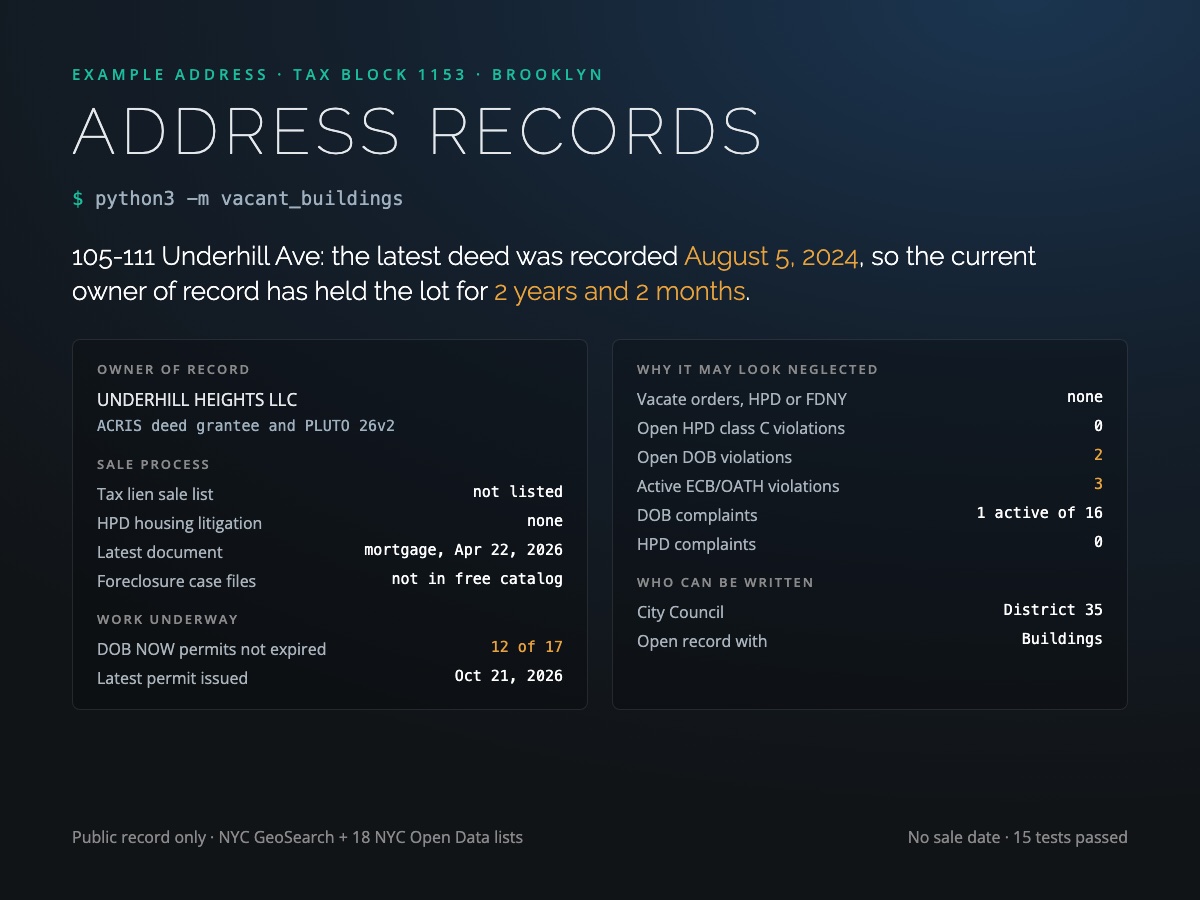
On October 29, 2026, I checked 105-111 Underhill Ave, Brooklyn, NY 11238. All four house numbers resolve to the same lot and building, so the report has one lot. Neither vacate list has a row for it, so the lead is the August 2024 deed.
PLUTO lists a two-floor building of class G1 with no residential units in an R6B zoning district, and neither certificate of occupancy file has a CO for the BIN since July 2012. No HPD registration, tax exemption, or abatement is on file.
Twelve DOB NOW permits have not yet expired, 311 has one dirty-condition request, and the open records are with the Department of Buildings. No court-linked recording, eviction, or HPD case is on file for the lot, and OATH lists 25 hearing tickets. That is not a finding that no court case exists, because state dockets were not searched.
Second example
I checked 36 Ditmars St, Brooklyn, NY, tax lot BBL 3031940023, on November 4, 2026. PLUTO lists a three-floor mixed residential and commercial building with five units, four of them residential. The city's hearings list was unavailable that day, so hearing tickets are not counted here.
This lot has much more on file than Underhill. It has 15 rows on the tax lien sale list, the latest on the June 1, 2025 list, which is a sale of the lien and not of the building. ACRIS has a court order recorded May 1, 2026, the marshal list has four executed evictions, the last in November 2018, and HPD shows two closed housing cases.
The condition counts are higher too: 2 open HPD class C violations, 17 open DOB violations, 18 active ECB violations, and 60 HPD and DOB complaints on file, none still open. Underhill's open records are all with Buildings and come with a dozen unexpired permits. Here the open records sit with HPD, Buildings, and Finance, and no DOB NOW permit is on file.
Limits
Every record shown comes from NYC Open Data, may be incomplete or delayed, and does not by itself show the cause of any condition.
Vacate orders were rare in any 12-month period, about 0.2% of lots, so the report lists them without estimating how likely a new one is. Stop-work orders, about 0.1% of lots in that check, are named as not yet in the report, because no list the report reads carries them. Emergency and unsafe-building declarations could not be studied from the complaint data used here, so the report does not summarise them.
The report does not link buildings by owner, developer, or contractor name, because a check of 100 sampled name matches per source could not confirm enough of them as the same company.
The web lookup reads 29 free NYC Open Data lists and NYC GeoSearch, and nothing else. A list that does not answer is reported as unavailable right now, not as none on file.
A lis pendens is filed with the county clerk, so a foreclosure filing does not show up in ACRIS. New York State court dockets, including Housing Court and Supreme Court foreclosure cases, are not searched, because eCourts has no public API; the report links eCourts for a search by hand. The bankruptcy name check runs only on the command line with a CourtListener token, and the web lookup skips it.
The certificate of occupancy files start in July 2012, so an older CO has to be looked up by hand in DOB's Building Information System. The council district map has the district number; the City Council Members dataset names the sitting member for that district when the lookup succeeds, falling back to the plain district line if it fails.
A tax lien sale listing is a sale of the tax lien, not of the building. The report prints no phone numbers, does not say whether anyone lives in a building, and does not predict a sale or give a likelihood.
Sources
- NYC Open Data
- NYC GeoSearch
- ACRIS: Automated City Register Information System
- New York State eCourts
- DOB Building Information System
- Python
- TypeScript
- Cloudflare Pages Functions
- NYC Open Data
- NYC GeoSearch
- ACRIS