The job
Official US election results come from county, parish, city, and township election offices, which also run most school, fire, and library district elections, and from the state offices that compile them. Much of the reporting already works: many states run central election-night systems, vendors put county feeds into one format, NIST Special Publication 1500-100 defines a federal Election Results Common Data Format, and the AP and other wire services sell vote counts and race calls.
What is missing is a free public record of what each office published and when. Election-night numbers are unofficial, the canvass revises them, and certification comes after, but an office's results page usually shows only its latest figures, so an earlier number can disappear when it is revised.
The public would get a dated history of how each official count changed. Someone who just wants the numbers would get the same official figures in one predictable format at a stable address, when a county page is a PDF, a slow spreadsheet, or offline. Businesses and small newsrooms without wire subscriptions would get machine-readable official results without retyping PDFs. They would not get the editorial judgment the wire services sell.
flowchart TB
  classDef office fill:#eff5f8,stroke:#547d91,color:#262626
  classDef process fill:#eaf8f4,stroke:#1abc9c,color:#262626
  classDef reader fill:#f3f3f3,stroke:#8a8a8a,color:#262626

  offices["Official election offices: county, parish, city, state"]
  intake["Signed submissions + ingest of existing public feeds"]
  normalize["Normalize to NIST SP 1500-100 Election Results CDF"]
  revisions[("Each count kept, including corrections
signed, labeled unofficial, canvass, or certified")]
  api["Free public read API
no race calls, no predictions"]
  readers["Readers: the public, state offices, and the press"]

  offices --> intake --> normalize --> revisions --> api --> readers

  class offices office
  class intake,normalize,revisions,api process
  class readers reader
How it works
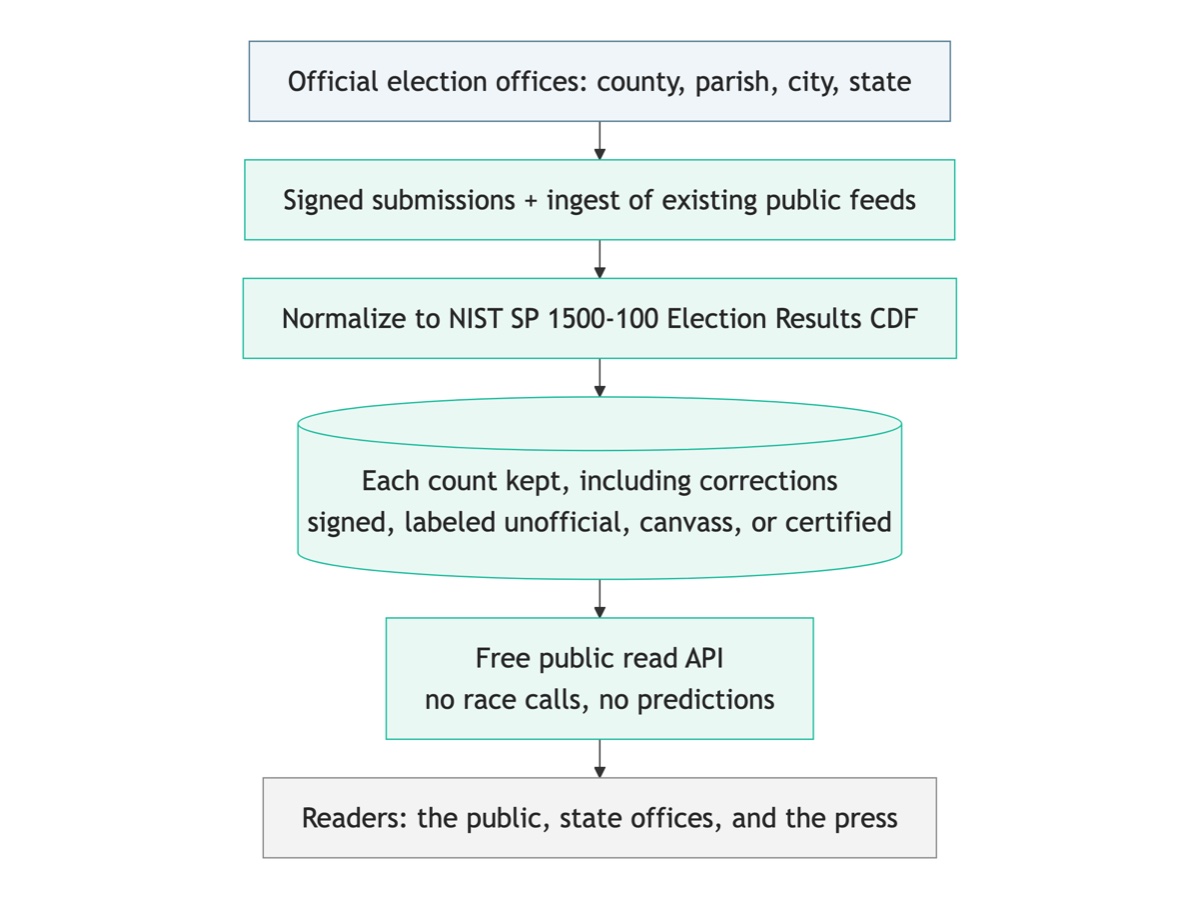
Offices would either sign their own submissions or let the project collect their existing public feeds, labeled as collected. Every version would be kept, normalized to the NIST format, signed, never overwritten, traced to its source, and labeled unofficial, canvass, or certified.
The code would be licensed under Apache-2.0, and the normalized results would be dedicated to the public domain under CC0-1.0, while each office's own publications keep their own terms.
Decision: hosting
Traffic is near zero for most of the year. Election night is a few hours of identical reads of small JSON files, so the files can be cached at the edge. A smaller bump follows during the canvass, and another at certification.
flowchart LR
  classDef office fill:#eff5f8,stroke:#547d91,color:#262626
  classDef process fill:#eaf8f4,stroke:#1abc9c,color:#262626
  classDef reader fill:#f3f3f3,stroke:#8a8a8a,color:#262626

  subgraph writePath["Write path"]
    direction TB
    offices["Official files in"]
    ingest["Signature check
the only writer"]
  end

  subgraph readPath["Read path"]
    direction TB
    objects[("Immutable objects
in R2")]
    cdn["CDN
serves cached files"]
  end

  readers["Readers"]

  offices --> ingest --> objects --> cdn --> readers

  class offices office
  class ingest,objects,cdn process
  class readers reader
I priced an idle month against an election-night spike, the same cost-and-scale check used at hedge funds and startups. The options were Cloudflare R2 plus its CDN, AWS S3 and CloudFront on pay as you go and on the flat-rate plans, and Google Cloud Storage plus Cloud CDN. The bill diverges on egress: R2 does not charge for it and cached reads are not billed, while AWS and Google Cloud bill the bytes leaving the network.
| Cloudflare | AWS pay as you go | AWS flat-rate | Google Cloud | |
|---|---|---|---|---|
| Idle | $0 | ~$0.05 | $0 | ~$18 (unverified) |
| Pilot night | $0 | $0 (free tier) | $15 | ~$26 |
| National night | $0 to $5 | ~$1,755 | $1,000 | ~$1,513 |
Read-path cost for an idle month, a pilot night, and a national night of about 1 billion requests and 10 TB. Google Cloud's idle load-balancer fee is unverified.
On these prices, Cloudflare is the one to use. The free plan has no uptime guarantee. Reading stays free, with no accounts and no private tier.
What it would take
It is worth building only if election offices sign their own submissions or let the project collect their official feeds with clear labels.
The first step would be a pilot with one or two counties that agree to one of those in writing, run through one live election.
Limits
Only official election offices could publish, and it would make no race calls or predictions. It is a concept: nothing has been built, and no election office or organization has adopted it.
Without office signatures or permission, it would be one more collector of public pages, which OpenElections, the closest project to work with, already does.
Sources
- NCSL: Election administration at state and local levels
- Louisiana R.S. 18:576: parish election night returns are unofficial
- Washington RCW 29A.04.330: the county auditor runs district special elections
- EAC: Election results, canvass, and certification
- NBC News: How votes are gathered on election night
- AP: How we declare winners
- NIST SP 1500-100 Rev. 2: Election Results Common Data Format
- OpenElections
- Apache License 2.0
- CC0 1.0 Universal
- Proposed
- Python
- NIST SP 1500-100
- Cloudflare R2
- Cloudflare Pages