The job
This is a work in progress. What is loaded is same-store revenue, expenses, and net operating income for six apartment companies, from the third quarter of 2024 through the third quarter of 2026, and only where revenue minus expenses equals the printed NOI. Guidance for the quarters before that latest quarter is still open. The forward log has fourth-quarter rows for two baselines. One repeats each company's third-quarter growth rate. The other works out the fourth quarter that each company's own full-year guidance implies. There is no score to show yet.
flowchart TB
  classDef office fill:#eff5f8,stroke:#547d91,color:#262626
  classDef process fill:#eaf8f4,stroke:#1abc9c,color:#262626
  classDef reader fill:#f3f3f3,stroke:#8a8a8a,color:#262626

  exhibit["Exhibit to the quarterly 8-K"]
  check["Revenue minus expenses equals NOI"]
  kept["Row kept, with the accession and the acceptance time"]
  blank["Row left blank, with the reason"]
  page["This page"]
  open["Still open
earlier guidance, rent, prices"]

  exhibit --> check
  check --> kept
  check --> blank
  kept --> page
  open --> page

  class exhibit office
  class check,kept,blank process
  class page,open reader
How it works
The companies print same-store results in an exhibit to the quarterly 8-K. Dollar amounts here are the printed thousands. A percent is the printed number, so 1.6 means 1.6 percent.
A row stays when revenue minus expenses equals NOI. Where the exhibit prints a growth percent, that percent has to match the change in the dollars, rounded half up to the printed places. Where a debt ladder was checked, the rows have to sum to the printed total. A figure that fails is left blank, with the reason. A later filing for the same quarter adds a row. The keys are the company, the quarter, the accession number, and the time EDGAR accepted the filing.
Each company writes its own definition of same-store. Equity Residential's history stays under its own file number. Vivmark is the renamed company after the merger, and AvalonBay's figures stay under AvalonBay. AvalonBay's last results quarter is the second quarter of 2026. The merger closed on August 17, 2026.
Decision: read the exhibit
Same-store NOI has no standard XBRL tag. On November 5, 2026, UDR was the only one of the five continuing companies with a third-quarter 10-Q in the facts feed, and that filing ties debt totals. The same-store figure still comes from the exhibit. UDR also files a PDF of the same exhibit, and the HTML and the PDF agree on the figures kept here. The choice is the HTML exhibit.
Result
Loaded so far. Third quarter of 2026, in the printed thousands.
| Company | Homes | NOI |
|---|---|---|
| Vivmark, merged pool | 157,377 | 976,542 |
| Essex | 52,059 | 313,188 |
| Mid-America | 96,562 | 316,039 |
| Camden | 51,087 | 210,925 |
| UDR, excluding the Apollo communities | 44,765 | 243,846 |
Camden's quarter is the check in one line: revenue of 332,846 minus expenses of 121,921 equals NOI of 210,925. The California portfolio, 11 communities and 3,620 homes, sold on July 29, 2026, and sits outside that comparison.
UDR prints NOI growth of 1.6 percent for the 44,765-home pool. Nineteen Apollo communities, 7,059 homes, are outside it.
Vivmark's merged pool is the first combined presentation. Equity Residential communities stay out of the company's own same-store set until January 1, 2028. The pre-merger results come from Equity Residential's records.
AvalonBay's second quarter of 2026, its last reported quarter, was NOI of 488,552 on 79,473 homes.
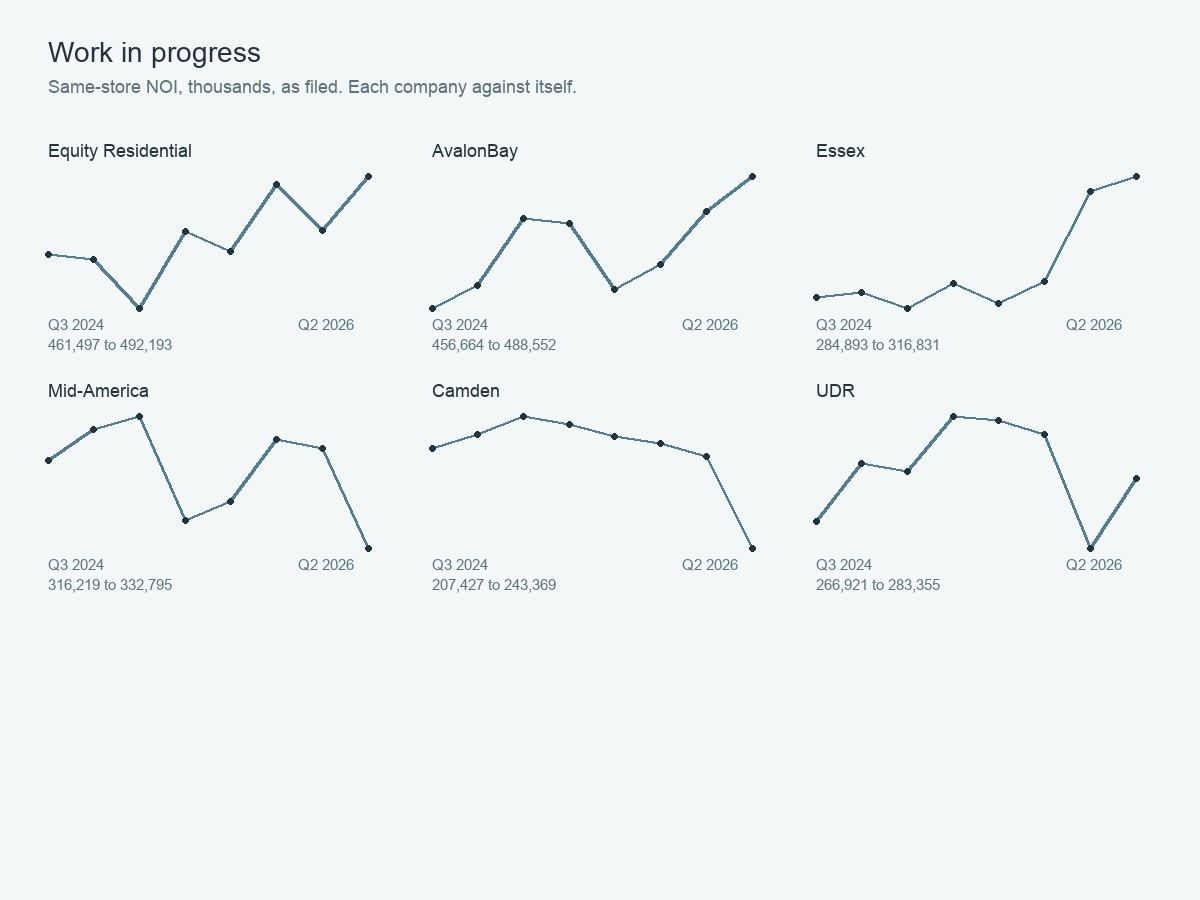
The chart at the top is the third quarter of 2024 through the second quarter of 2026. Those quarters passed the same check. Each line is one company against itself.
The forward log is open. The first quarter that can be scored is the fourth quarter of 2026. A row has to be written before December 31, 2026. A row written on that day or later is rejected. Two baselines will sit beside any rule: repeat the current quarter, and take the midpoint of the company's own guidance. Quarters already filed are for checking the load.
Version 0 of the forward rule repeats each company's own third-quarter 2026 same-store NOI growth as the fourth-quarter baseline. Five rows are in the log, recorded at 2026-11-17T01:28:57+00:00, with the cutoff at quarter end: Camden (CPT) -0.2 percent, Essex (ESS) 3.1 percent, Mid-America (MAA) -1.8 percent, UDR 1.6 percent, and Vivmark (VMRK) 1.7 percent. Each figure is that third-quarter rate repeated. No separate forecast was entered.
Version 1 is the second baseline. Each company gives a range for full-year 2026 same-store NOI growth. Take the middle of that range, and ask what fourth-quarter growth would land the full year on it. The inputs are the company's year-to-date 2026 same-store NOI, the same nine months of 2025, and the fourth quarter of 2025. All three come from filings made before the row was written, on the same pool of homes the guidance covers. Three rows are in the log, recorded at 2026-11-17T01:56:09+00:00, with the cutoff at quarter end: Camden -1.8 percent, Essex +2.2 percent, and Vivmark +0.5 percent. Vivmark's guidance covers its merged same-store portfolio. The filing defines that NOI as residential revenue less operating expenses on its 157,377 apartment homes, and that is the pool used. Mid-America and UDR were left out, because their filings do not report those figures on the pool of homes their guidance covers. The repository stays private until the first scored quarter.
Limits
Five companies continue. A year of scoring is a few dozen company-quarters. That can say whether a rule beats both baselines more often than not. A claim about beating the market would need a much larger set. Any later score will have the count beside it.
There is no shared definition of same-store. A company is compared with itself, and a quarter whose pool changed is flagged.
No NAV, no cap rate, no rating, and no buy or sell view.
Matthew Dickson already parses these companies from the filings back to 2010 and goes on to cap rates. The difference here is the as-filed number, a blank when the check fails, and a score only for a quarter written down before the cutoff.
The filing files stay off this site. Guidance for the earlier quarters, monthly rent, and prices are still open.
Sources
- Equity Residential and Vivmark, CIK 906107
- AvalonBay, CIK 915912
- Essex, CIK 920522
- Mid-America, CIK 912595
- Camden, CIK 906345
- UDR, CIK 74208
- Matthew Dickson, REIT parsing
- Python
- EDGAR
- Astro
- Cloudflare Pages